RSS
Showing posts with label Plant of the Week. Show all posts

Monday, December 1, 2008

Plant of the Week

Name: Oca
Latin Name: Oxalis tuberosa
Origin: Andes Mountains, Peru

Oca is a little known root crop that is native to the Andes mountains. The starchy tubers are somewhat similar to potato or Jerusalem artichoke. The leaves are also edible, since it is in the same genus (Oxalis) as wood sorrels common in the U.S.

Oca is a staple food in the upper Andes mountains, and is common in New Zealand as a 'yam.' It is even fairly easy to get a hold of in Europe. (At least as a garden plant, if not a grocery item.)

The main reason that it isn't popular here is that it requires growing conditions that are fairly difficult to come by in the U.S. climate zones. It needs a long growing season, and it is also daylength dependent. It also doesn't tolerate heat or frost very well. In other words, it won't develop its tubers until there is less than 12 hours of sunlight each day. But it doesn't like the heat of mid-summer or the below freezing temperatures. The main problem is that we usually have a frost before the tubers have developed to full size. Still, there are ways that this could be manipulated or overcome, at least on a home garden scale.

Monday, October 27, 2008

Plant of the Week

Name: Watermelon Radish, aka Red Meat Radish, aka Mantanghong Radish, aka Beauty Heart
Latin Name: umm...I couldn't actually find this, so I think I'm going to go with Raphanus sativus barring a better solution.
Origin: east Asia

I personally prefer the name Watermelon Radish, because it is simple, beautiful, and it confuses people. Therefore, that is what I will be calling it for this post. Watermelon radish is a type of daikon radish. Hence, it is a fall/winter radish. (Um, for those of you in northern Wisconsin, that makes it a 'summer' radish...you can probably plant it in July and harvest in September.)

Anyway, unlike a "normal" radish, it is not spicy. It does taste like a radish, but the interior pink part is sweet and nutty with no heat. The white/green edge has a kick to it though. Also unlike a "normal" radish, it does not get woody and disgusting when its diameter exceeds 1 inch. This radish is supposed to have a diameter in excess of 3 inches.

Other than those differences, it really is similar to other radishes. The leaves are similar, although they do make a bigger plant. The seeds germinate quickly, and the plant itself grows quite quickly too. Flea beetles or a rogue cabbageworm (also known as those green worms on my broccoli/cauliflower/cabbage) will cause the most damage to the plants, but even they are relatively uncommon.

I really like eating watermelon radishes raw, but there are numerous recipes for them. Because they are Chinese radishes, there are a number of recipes for stir-fry and such things.

Monday, September 22, 2008

Plant of the Week

Name: Garlic Chives
Latin Name: Allium tuberosum
Origin: China, or other parts of the Orient

If you've ever seen or grown chives, then garlic chives won't seem altogether strange. They have a very similar growth habit to regular chives, but have a strong garlicky flavor rather than a mild onion taste. (Ha, I bet that's why they're called garlic chives!)

Garlic chives have flat leaves, rather than the characteristic tubular leaves of most Alliums, including chives and onions. They also have clusters of white, star-shaped flowers that bloom in the late summer/early fall. (Regular chives usually bloom in the spring.)

Garlic chives, like regular chives, can be propagated from seeds or by division. They are perennials and generally hardy to zone 3.

Monday, September 15, 2008

Plant of the Week

Name: Winter Savory
Latin Name: Satureja montana
Origin: Southern Europe

Winter savory is a semi-evergreen herb that has been very common in cooking in the past, although it is currently somewhat overshadowed by other herbs. It is hardy to zone 4-5, and is really pretty low maintenance. It can get woody as it grows, but the early spring stems and the new growth are nice and tender and flavorful. It doesn't need much water, and herbs in general don't need a lot of fertilizer.

Winter savory is usually used with other herbs like thyme, basil, and oregano. It is supposed to go well with beans, chicken, and other meat.

Monday, September 8, 2008

Plant of the Week

Name: Angelonia
Latin Name: Angelonia angustifolia
Origin: Mexico and the West Indies

Angelonia is a perennial flower that is hardy only to zone 8 or so, which means that most of us treat it as an annual. The flowers are sometimes called "snapdragon-like," probably because they are arranged on vertical stems like snapdragon, and the individual florets are somewhat similar to the open-type snapdragons.

Angelonia bloom more or less continuously throughout the summer (although I suspect they would take a few weeks off here during the worst of the heat). They are various shades of pink, white, purple/lavendar/blue.

Monday, September 1, 2008

Plant of the Week

Name: Seaberry, aka Sea Buckthorn
Latin Name: Hippophae rhamnoides
Origin: Various species native to Europe and Asia

Seaberry is a deciduous shrub that has bright orange or yellow berries. It has become increasingly popular in Europe, particularly in the Scandinavian countries. The berries are very high in antioxidants, vitamin C, and other good things. The berries are pea-sized, and held close to the branches. Unfortunately, the branches are liberally sprinkled with large thorns. As you can imagine, this makes harvesting rather difficult. In fact, I believe it is most common to harvest by pruning off the berry-containing branches and freezing them, then knocking the berries off and making juice or puree.

You need a male plant and a female plant to get any fruit. The plants are quite hardy as they are native to maritime climates. They will tolerate salty air and soil, poor soils, wet soils, and they fix nitrogen in the soil similar to legumes.

They are hardy to -25 degrees C, or -15 degrees F. I think that translates to...zone 5.

Tuesday, August 26, 2008

Plant of the Week

Name: Pummelo

I'm really, really lazy this week (and last week too!) so I'm just going to direct you to this link to read all about pummelo.

Monday, August 11, 2008

Plant of the Week: Fennel

Name: Fennel
Latin Name: Foeniculum vulgare
Origin: Indigenous to the shores of the Mediterranean

Is it an herb? Is it a vegetable? Is it a flower? It's not a tree, that's for sure. (Although it is in the Magnolia Class...not that that makes it a Magnolia tree...) Fennel is probably most commonly known as an herb, where you use the seed as a flavoring or spice in dishes. Somewhat less common is using the "bulb" - er...well...swollen crown just above the soil level (think kohlrabi, if you know what that is). The type of fennel with the swollen bulbs is called "Florence" fennel. (Think Florence, Italy.) The bulbs are probably most commonly found in Italian cuisine, although not in spaghetti. The seeds are particularly important in some types of Indian and Middle Easter cuisine.

The fennel fronds (think leaves) and flowers are also quite tasty. I actually prefer eating little pieces of the flowers. (Well, it would actually be a small bunch of flowers from part of the raceme of flowers...or maybe it's an umbel. I forget. I think it is an umbel. Yup...Umbel family. That makes it an umbel.) (This post has a lot of parentheses. I must be feeling parenthetical today.) Anyway, back to the point. Fennel pollen is considered a delicacy...an expensive delicacy, for sure. Think about it. When is the last time you tried harvesting a reasonable amount of pollen from anything, let alone an itty bitty tiny flower like fennel?

Fennel can be grown from seed, and will grow year round - in Mediterranean-like climates. There are also bronze fennels, which have reddish fronds, but do not form bulbs. The bulbs take pretty much the whole growing seasone to form, although the fronds and flowers show up sooner.

Monday, August 4, 2008

Plant of the Week: Variegated Maple

Name: Variegated Maple (Click for picture, as per usual)
Latin Name: Acer platanoides 'Variegatum'
Origin: A selection of a Norway Maple...It would seem logical that the Norway Maple originated in Norway, but according to Wikipedia, it actually is native to eastern and central Europe and southwest Asia, from France east to Russia, north to southern Scandinavia and southeast to northern Iran. So I guess it might have originally come from Norway.

This particular maple tree is hardy to zone 4 and prefers full sun. Well...most trees do, really. At full size, it will be 50-60 feet tall and 40-50 feet wide. It is an upright tree with really cool white and green variegated leaves. Really, if you haven't looked at the pictures yet, please do.

Tuesday, July 29, 2008

Plant of the Week: Gladiolus

Name: Gladiolus (click to see a whole array of glads)
Latin Name: Gladiolus sp.
Origin: Sub-Saharan Africa, esp. South Africa

Gladiolus are definitely one of my all-time favorite flowers, but only when they are fresh out of the garden...or in pictures in the catalogs. I have to be honest that gladiolus from florists tend to leave me a little bit cold. Anyway, I'm sure that my love affair with "glads" is due to winning a big ribbon at the county fair when I was a tender 5 or 6 years old. I believe those were 'Priscilla' variety glads, white petals with a pale yellow throat and pink edges. They are still my favorites, although there are lots of other cool ones as well.

Gladiolus are actually a number of florets on a stalk, and what most people probably don't realize is that the florets only have 3 petals. The other 3 petal-like structures are actually sepals, even though they look virtually identical to the petals. In recent years, there have been several newer kinds of gladiolus released to the general public that are smaller and more orchid-like that the typical tall, standard-types.

In most cooler climates, gladiolus corms (you might call them bulbs) should be planted in the spring and then dug up in the fall. They can be replanted for several years before getting too small to support a nice flower stalk.

P.S. And yes, gladiolus are edible...the petals can be eaten and taste kind of like lettuce with a tinge of sugar.

Monday, July 21, 2008

Plant of the Week: Buffalograss

Common Name: Buffalograss (Click for picture)
Latin Name: Buchloe dactyloides
Origin: Great Plains


I know this is something of a switch in the Plant of the Week, but I thought it would be a fun change. Buffalograss is native to the Great Plains, and is one of the warm season grasses that can be used for lawn or turf grasses in southern Kansas, and points farther south. It is particularly well adapted to soils that are heavy clay and to climates that are not extremely cold in the winter but have hot, dry summers. It is a very fine-leaved grass with a blue-gray-green color. It spreads by aboveground stolons.

Buffalograss is not particularly invasive, especially compared to Bermudagrass. It also requires little or no irrigation or fertilization, which makes it the grass of choice for those looking for a low maintenance or "earth friendly" lawn. The downside is that it is dormant (brown) during the cool early spring and late fall, which apparently people can't handle.

Buffalograss, being native to the prairie, is not perfect for a monoculture lawn either. It will tend to allow a few weeds to compete and live side-by-side.

Monday, July 14, 2008

Plant of the Week: Arugula

Common Name: Arugula (Click for picture and for nutrition information)
Latin Name: Eruca sativa
Origin: Mediterranean

Arugula is an annual salad green that is becoming increasingly common in grocery stores. It is in many of the salad mixes, and can even be found individually at times. It has a quite strong peppery flavor which you either like or dislike. I, personally, am not that fond of arugula unless it is mixed in with lots of other things.

Arugula is a member of the Brassica family, like mustards, turnips, broccoli, cauliflower, etc. It does have a flavor similar to mustards and turnips, but I would say it is much stronger and sharply flavored than other Brassicas. It can be used cooked or raw.

Growing arugula is quite easy, really. You can plant the seeds and harvest baby sized greens in about 45 days.

Monday, July 7, 2008

Plant of the Week: Cuban Oregano

Common Name: Cuban Oregano (Click for picture)
Latin Name: Plectranthus amboinicus
Origin: Africa...no, it doesn't make sense...

Cuban Oregano is a tender perennial (which means annual for those of you living in Zone 7 or colder). Some people also call it Spanish Thyme. It can be variegated or plain green. It is a very succulent plant...leaves are very fleshy and juicy. The leaves also tend to be velvety and covered with hairs. It is a very spicy, strong smelling plant, and apparently is unique for culinary purposes. I've never actually tried using it in cooking, so I'm afraid I can't recommend any uses.

It is quite attractive in a hanging basket or planted in the garden. It prefers hot, humid conditions, and either partial shade or full sun. Basically, if you are in a really hot, searing location then I'd go with part shade. It is going to be a pretty slow growing plant until the heat of the summer shows up. It is very easy to propagate. You can pretty much drop a leaf on some moist soil and it will root and start growing.

Monday, June 30, 2008

Plant of the Week: Torenia

Common Name: Torenia, aka Wishbone Flower (Click for picture)
Latin Name: Torenia fournieri
Origin: Taiwan?

Torenia is an annual flower that will grow in both sun and part-shade. I'm guessing that here in Kansas, it really does best in part-shade and not so well in full sun. In the farther northern climes, it will most likely enjoy a bit more sun.

The plant tends to have a trailing habit, making it great for hanging baskets or container plantings. I personally am fond of it because it has such cheery, funny looking flowers. They have a classic trumpet shaped flower, and they usually have some sort of bicolor pattern that is reminiscent of a clown face, hence some of the older 'Clown Series' varieties of Torenia.

Monday, June 23, 2008

Plant of the Week: Asian Pear

Common Name: Asian Pear (Click for picture)
Latin Name: Pyrus pyrifolia
Origin: Asia! (Japan/Korea)

Asian pears are also known as apple pears. They are crunchy and sweet, having a texture more like we would expect of an apple. They are not baked or used much like European pears (the kind we normally eat in the U.S.) because of their texture.

Unlike European pears, Asian pears can be eaten fresh off the tree. (Which in itself is an interesting aside. European pears must be picked and stored before they ripen fully. They won't ripen fully while on the tree.) Asian pears can also be stored for several months and still be good. There are 3 types of Asian pears. They are 1) round or flat fruit with green-to-yellow skin, 2) round or flat fruit with bronze-colored skin and a light bronze-russet, 3) pear-shaped fruit with green or russet skin.

Monday, June 16, 2008

Plant of the Week: Patty Pan Squash

Common Name: Patty Pan Squash, Scallopini (Click for picture)
Latin Name: Cucurbita pepo
Origin: Good question.

Patty Pan squash is just one type of summer squash, along with zucchini, straightneck, and crookneck squashes. It is distinctive in that it has round, saucer-like fruit, often with scalloped edges. It can be yellow, pale yellow, white, pale green, dark green, and yellow/green bicolor.

The plant is grown like any other summer squash...planted by seed after the soil and temperatures are warm in the spring. The plants are not trailing, for the most part. They instead tend to be quite bushy and compact, especially if you are used to growing pumpkins that vine all over creation.

Patty Pan squash are best used when they are still quite small - only 3" in diameter. They can be cooked like any other summer squash. The amount of chopping is entirely dependent on the size at harvest. They can also be good baked whole and stuffed with other tasty things.

Monday, June 9, 2008

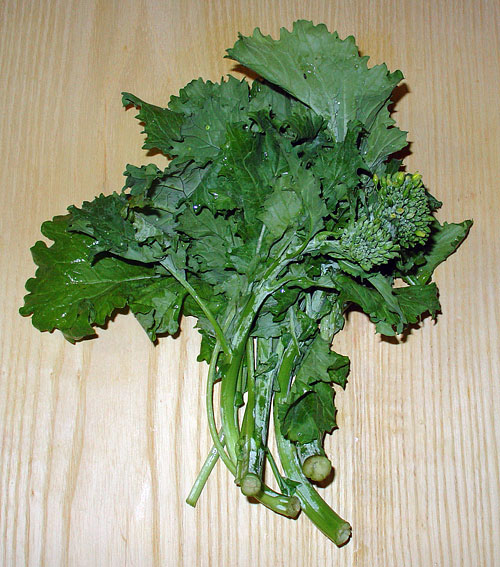
Plant of the Week: Broccoli Raab

Common Name: Broccoli Raab, Rapini, Broccoli Rabe, Cima de rapa, etc. (Click for picture)
Latin Name: Brassica rapa sb. rapa
Origin: usually considered Italian, some sources say China

The best way to describe broccoli raab is that it is like a cross between a broccoli plant and a turnip plant. The leaves look more like a turnip, and the lifespan of the plant is much more reminiscent of a turnip. But the silly thing does have some little florets amongst the leaves that are like broccoli. It has a strong, sharp flavor that some say is an acquired taste. (But then, I think most people feel that broccoli and turnips are also acquired tastes...)

Broccoli raab is usually planted in the spring for an early crop and again in mid- to late-summer for a fall crop. It takes about 45-60 days to reach maturity from seed. You want to harvest the leaves and florets together and use them all. Here's a link to some recipes:

http://www.mariquita.com/recipes/broccoli%20raab.html

Monday, June 2, 2008

Plant of the Week: Lemon Verbena

Yay! New feature on the blog! Since I make my living as a horticulturist, I might as well share the goodness with you all, right? So, a new feature...a Plant of the Week!

Common Name: Lemon Verbena (click for a picture)
Latin Name: Aloysia triphylla
General Grouping: Herb

Lemon Verbena is an herb that I first met at my previous job, and I have since then fallen in love with it. It has beautiful sword-shaped, dark green leaves and grows big and luscious when it is happy with its situation. In tropical regions, it can be a 15' woody shrub. In the U.S., it is lucky to get 3' tall. It loves sun and will tolerate some dry conditions.

Supposedly you can grow it from seed, but I've only ever propagated it from cuttings. Cuttings seem like the easier route, in my opinion.

Its main selling point is the wonderful sweet lemon fragrance and taste. I guess you would call it a gourmet herb. One thing that I'm considering trying with my plant is taking some fresh leaves and blending them into some sugar. Then I can use the sugar in cookies or cake or other good things that I come up with.